Sentiment analysis is a technology that uses Artificial Intelligence (AI) and Natural Language Processing (NLP) to identify and interpret the emotional tone behind text. It helps determine whether a piece of content expresses a positive, negative, or neutral opinion.
In simple terms, sentiment analysis helps businesses understand how people feel about their brand, products, services, or campaigns.
1.1How It Works Sentiment Analysis
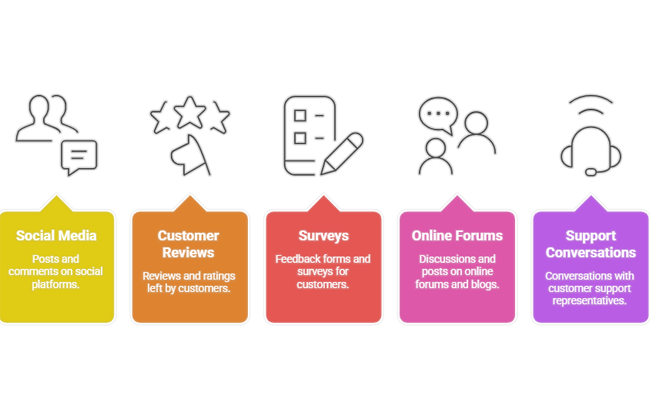
Sentiment analysis analyzes text from sources such as:
• Social media posts and comments
• Customer reviews and ratings
• Surveys and feedback forms
• Online forums and blogs
• Customer support conversations
The system processes the language, context, and keywords to classify the sentiment and often assigns a sentiment score to measure the intensity of the emotion.
1.2Types of Sentiment Analysis
•Polarity Detection — Classifies content as Positive, Negative, or Neutral.
•Fine-Grained Sentiment — Provides deeper classification such as Very positive, Positive, Neutral, Negative, or Very negative.
•Aspect-Based Sentiment Analysis — Identifies sentiment about specific features or topics. Example: "Great design but expensive" — Positive: Design, Negative: Price.
•Emotion Detection — Advanced models can identify emotions like Satisfaction, Frustration, Excitement, and Anger.
1.3Why It Matters
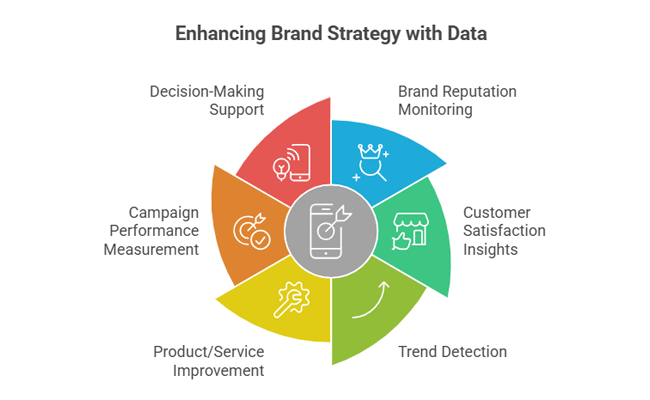
Sentiment analysis helps organizations:
• Monitor brand reputation
• Understand customer satisfaction
• Detect negative trends early
• Improve products and services
• Measure campaign performance
• Support data-driven decision-making
When combined with social listening services, NLP sentiment analysis provides real-time insights into public perception and helps businesses turn customer conversations into actionable intelligence.
2. Benefits of Sentiment Analysis
Sentiment analysis helps businesses move beyond basic data and understand the emotions behind customer conversations. By analyzing opinions across social media, reviews, surveys, and online platforms, organizations can make smarter decisions, improve customer experience, and protect their brand reputation.
Here are the key benefits of sentiment analysis:
2.1 Real-Time Brand Monitoring
Sentiment analysis allows businesses to track how customers feel about their brand as conversations happen. Instead of relying on delayed reports or manual analysis, teams can monitor public perception in real time and respond quickly to changes.
This helps brands stay aware of:
• Public opinion trends
• Customer reactions to campaigns
• Emerging issues or concerns
2.2 Early Detection of Reputation Risks
Negative conversations can spread quickly and impact brand trust. Sentiment analysis identifies sudden increases in negative sentiment, allowing businesses to take action before the situation escalates into a PR crisis.
Early alerts help organizations:
• Address customer complaints quickly
• Manage potential crises
• Protect brand reputation
2.3 Improved Customer Experience
By analyzing customer feedback at scale, businesses can identify recurring issues, service gaps, or product frustrations. These insights help teams fix problems faster and improve overall customer satisfaction.
Sentiment insights support:
• Better support processes
• Faster issue resolution
• More customer-centric strategies
2.4 Data-Driven Decision Making
Sentiment analysis provides clear insights into what customers like, dislike, and expect. This helps businesses make informed decisions across marketing, product development, and customer service instead of relying on assumptions.
2.5 Better Campaign Performance Insights
Marketers can measure how audiences emotionally respond to campaigns, product launches, or brand messaging. Understanding sentiment helps optimize content, messaging, and targeting for stronger engagement and ROI.
2.6 Competitive Intelligence
Sentiment analysis can track how customers feel about competitors as well. By comparing sentiment trends, businesses can identify competitor weaknesses, market gaps, and opportunities for differentiation.
2.7 Product and Service Improvement
Aspect-based sentiment analysis highlights feedback related to specific features, pricing, quality, or usability. This helps product teams prioritize improvements based on real customer needs.
2.8 Trend and Market Insight
Customer conversations often reveal emerging trends, changing expectations, or new demands. Sentiment analysis helps businesses identify these patterns early and stay ahead of the market.
2.9 Scalable Feedback Analysis
Manually reviewing thousands of comments or reviews is time-consuming and inefficient. Sentiment analysis automates this process, enabling organizations to analyze large volumes of data quickly and accurately.
2.10 Stronger Customer Relationships
When businesses understand customer emotions and respond appropriately, it builds trust, loyalty, and long-term engagement.
3. Business Applications for Sentiment Analysis
Sentiment analysis is no longer limited to understanding customer opinions — it has become a strategic tool that supports multiple business functions. By analyzing emotions across conversations, reviews, and feedback channels, organizations can improve decision-making, enhance customer experience, and strengthen brand performance.
Here are the key business applications of sentiment analysis:
3.1 Brand Reputation Management
One of the most important uses of sentiment analysis is monitoring brand perception across digital channels. Businesses can track how public opinion changes over time and identify negative sentiment before it impacts their reputation.
This helps organizations:
• Detect reputation risks early
• Respond quickly to negative conversations
• Maintain a positive brand image
3.2 Social Listening and Marketing Optimization
Sentiment analysis plays a critical role in social listening Services by helping marketers understand audience reactions to campaigns, product launches, and brand messaging.
Marketing teams can:
• Measure emotional response to campaigns
• Identify content that resonates with audiences
• Optimize messaging and targeting
• Improve engagement and ROI
3.3 Voice of Customer (VoC) Analysis
Customers share feedback across multiple platforms, including surveys, reviews, social media, and support interactions. NLP Sentiment analysis consolidates and analyzes this feedback to reveal customer satisfaction levels and key concerns.
This enables businesses to:
• Understand customer expectations
• Identify pain points
• Improve customer journey and experience
3.4 Product Development and Innovation
Customer conversations often contain valuable insights about product performance, usability, and desired features. Aspect-based sentiment analysis helps product teams understand sentiment related to specific features.
Businesses can use these insights to:
• Prioritize product improvements
• Fix quality or usability issues
• Identify new feature opportunities
• Align development with customer needs
3.5 Customer Support Optimization
Analyzing sentiment in support tickets, chat interactions, and complaints helps organizations identify recurring issues and service gaps.
This supports:
• Faster issue resolution
• Better support workflows
• Improved customer satisfaction
3.6 Competitive Intelligence
Sentiment analysis allows businesses to monitor how customers feel about competitors. By comparing sentiment trends, organizations can understand their market position and identify opportunities for differentiation.
Key insights include:
• Competitor strengths and weaknesses
• Share of positive vs negative sentiment
• Market perception trends
3.7 Crisis Detection and Risk Management
Sudden spikes in negative sentiment often indicate potential issues such as product failures, service outages, or negative publicity. Real-time sentiment monitoring helps organizations respond quickly and minimize damage.
This is especially valuable for:
• PR teams
• Brand managers
• Corporate communications
3.8 Market Research and Trend Analysis
Sentiment analysis helps businesses identify emerging topics, shifting customer preferences, and industry trends. These insights support strategic planning and help organizations stay ahead of market changes.
3.9 Influencer and Audience Analysis
Brands can analyze sentiment around influencers, creators, or brand advocates to identify voices that generate positive engagement and credibility.
3.10 Sales and Lead Intelligence
Sentiment analysis can identify potential buying intent or dissatisfaction with competitors, helping sales teams target the right opportunities.
When integrated with AI-powered social listening platforms, sentiment analysis transforms everyday conversations into actionable business intelligence, helping organizations make smarter decisions and drive long-term growth.
4. Sentiment Analysis Case Study
Industry: E-commerce Retail
Objective: Improve customer satisfaction and reduce negative brand perception by identifying key issues affecting customer experience.
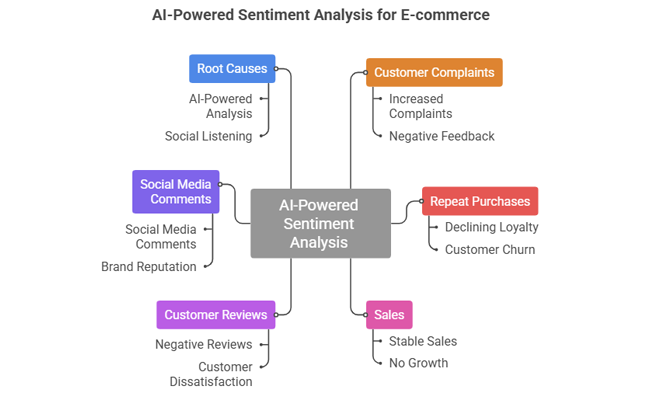
A fast-growing e-commerce brand noticed an increase in customer complaints and a decline in repeat purchases. While sales remained stable, customer reviews and social media comments suggested growing dissatisfaction. The company decided to implement AI-powered sentiment analysis with social listening services to understand the root causes behind negative feedback.
4.1 Data Sources Analyzed
The sentiment analysis platform collected and analyzed conversations from:
• Social media mentions (Twitter, Instagram, Facebook)
• Product reviews and ratings
• Customer support tickets and chat logs
• Online forums and community discussions
• Post-purchase survey responses
Over 250,000 customer interactions were analyzed within 60 days.
4.2 Key Insights from Sentiment Analysis
4.2.1Increase in Negative Sentiment
Overall sentiment trends showed: Positive: 52%, Neutral: 18%, Negative: 30%. Negative sentiment had increased by 22% compared to the previous quarter.
4.2.2Aspect-Based Sentiment Findings
The analysis identified specific drivers behind customer dissatisfaction:
•Delivery Time — Negative: Delays during peak periods
•Packaging — Negative: Damaged or poor-quality packaging
•Product Quality — Mixed: Issues with certain categories
•Pricing — Positive: Customers found pricing competitive
•Website Experience — Positive: Easy navigation and checkout
4.2.3 Emerging Risk Signals
Real-time monitoring detected:
• Sudden spikes in complaints during sales events
• Viral posts about damaged products
• Increasing mentions of competitor alternatives
Actions Taken
Based on sentiment insights, the company implemented the following changes:
•Operations: Partnered with additional logistics providers to reduce delivery delays; introduced quality checks for packaging
•Customer Experience: Proactive notifications for delayed orders; faster response times for complaints
•Marketing: Highlighted improved packaging and faster delivery in campaigns; launched customer reassurance messaging
This case study demonstrates how sentiment analysis helped the brand identify root causes of customer dissatisfaction, take data-driven operational and marketing actions, improve customer trust and loyalty, protect brand reputation, and increase long-term revenue potential.
5. How Does Sentiment Analysis Work?
Sentiment analysis works by using Artificial Intelligence (AI), Natural Language Processing (NLP), and machine learning to identify and interpret the emotional tone behind text. It analyzes large volumes of unstructured data and classifies conversations as positive, negative, or neutral — often with deeper emotional insights.
Here is a step-by-step breakdown of how sentiment analysis works:
5.1 Data Collection
The first step is gathering text data from multiple sources where customers share opinions, such as:
• Social media platforms (Twitter, LinkedIn, Instagram, Facebook)
• Online reviews and ratings
• Customer surveys and feedback forms
• Support tickets and chat conversations
• Forums, blogs, and online communities
• News and media mentions
5.2 Data Cleaning and Preparation
Raw text data often contains noise such as spam or irrelevant mentions, emojis and special characters, slang or abbreviations, and duplicate content. NLP techniques clean and standardize the text by removing irrelevant elements, correcting formatting, identifying language and context, and tokenizing text.
5.3 Text Understanding with NLP
Natural Language Processing helps the system understand:
Advanced sentiment analysis identifies sentiment related to specific features or topics.
Example:
"The camera is great, but the battery drains fast."
• Positive: Camera
• Negative: Battery
This helps businesses understand exactly what customers like or dislike.
5.6 Aggregation and Trend Analysis
Once individual sentiments are classified, the system aggregates the data to show:
• Overall sentiment trends over time
• Positive vs negative ratios
• Sentiment by channel or region
• Sentiment drivers and key topics
• Brand health scores
This makes it easier to identify patterns and changes in public perception.
5.7 Visualization and Reporting
The insights are presented through dashboards and reports, including:
• Real-time sentiment monitoring
• Alerts for negative sentiment spikes
• Campaign performance analysis
• Competitive sentiment comparison
• Voice of Customer insights
These visualizations help teams make faster, data-driven decisions.
6. What Are the Current Challenges for Sentiment Analysis?
While sentiment analysis has become a powerful tool for understanding customer emotions and brand perception, it still faces several challenges. Human language is complex, nuanced, and constantly evolving, which makes accurate interpretation difficult — even for advanced AI systems.
Understanding these limitations helps businesses choose the right tools and use sentiment insights more effectively.
6.1 Understanding Context and Sarcasm
One of the biggest challenges in sentiment analysis is interpreting context correctly. People often use sarcasm, irony, or humor that can mislead automated systems.
Example:
"Great, my order arrived two days late. Fantastic service!"
Although the word great appears positive, the actual sentiment is negative. Detecting such nuances requires advanced contextual AI models.
6.2 Mixed or Ambiguous Sentiment
Many customer comments contain both positive and negative opinions.
Example:
"The product quality is excellent, but the delivery was slow."
Basic sentiment analysis may classify this as neutral, missing important insights. This is why aspect-based sentiment analysis is essential, but also more complex to implement.
6.3 Multilingual and Regional Language Variations
Global brands must analyze sentiment across multiple languages, dialects, and cultural expressions. Slang, local phrases, and regional tone variations can affect accuracy if models are not properly trained for those languages.
6.4 Industry-Specific Terminology
Different industries use specialized language that generic sentiment models may misinterpret.
Example:
• In finance: "risk exposure" may be neutral
• In healthcare: "critical condition" is negative
• In gaming: "sick performance" could be positive
Custom training and domain-specific models are often required.
6.5 Handling Emojis, Slang, and Informal Language
Social media conversations often include:
• Emojis and emoticons
• Abbreviations (LOL, IMO, etc.)
• Misspellings
• Informal or conversational tone
Interpreting these correctly is essential for accurate nlp and sentiment analysis, but can be challenging for traditional models.
6.6 Data Noise and Irrelevant Mentions
Not all brand mentions are meaningful. Common issues include:
• Spam and bot-generated content
• Irrelevant keyword matches
• Duplicate conversations
• Promotional or unrelated posts
Filtering out noise is necessary to ensure reliable insights.
6.7 Rapidly Changing Language Trends
Language evolves quickly, especially on social media. New slang, memes, and expressions appear frequently, and sentiment models must be updated regularly to stay accurate.
6.8 Limited Emotion Depth
Basic sentiment analysis focuses only on positive, negative, or neutral classifications. However, real customer emotions are more complex, including frustration, excitement, disappointment, or trust.
Capturing deeper emotional signals requires advanced AI and emotion detection capabilities.
6.9 Bias in Training Data
If sentiment models are trained on biased or limited datasets, they may produce inaccurate or skewed results. Continuous model training and validation are essential to maintain fairness and accuracy.
6.10 Real-Time Processing at Scale
Analyzing large volumes of data from multiple platforms in real time requires strong infrastructure and advanced processing capabilities. Performance and scalability can be a challenge for some tools.
7.How Modern Platforms Address These Challenges
Advanced AI-powered sentiment analysis and social listening platforms improve accuracy through:
• Deep learning and transformer-based models
• Contextual language understanding
• Multilingual NLP support
• Aspect-based sentiment analysis
• Continuous model training and updates
• Noise filtering and data validation
7.1 Using Marcitors for Powerful Sentiment Analysis Insights
Understanding customer emotions is only valuable when insights are clear, actionable, and easy to apply across the business. This is where advanced platforms like Thematic help organizations turn large volumes of unstructured feedback into meaningful sentiment and theme-based insights.
By combining AI-powered sentiment analysis with marcitors clustering, businesses can go beyond basic positive or negative classification and uncover the real drivers behind customer opinions.
7.2 What Makes Marcitors Different?
Traditional sentiment analysis focuses only on polarity (positive, negative, neutral). Marcitors enhances this approach by automatically identifying themes, topics, and patterns within customer feedback and linking them to sentiment.
This allows businesses to answer critical questions such as:
• Why is sentiment declining?
• What specific issues are customers talking about?
• Which features drive positive feedback?
• What problems need immediate attention?
7.3 Key Capabilities of Marcitors for Sentiment Analysis
7.3.1 Theme Detection with Sentiment Context
Marcitors automatically groups customer comments into meaningful themes such as:
• Delivery delays
• Product quality
• Customer support
• Pricing concerns
• User experience
Each theme is analyzed alongside sentiment to identify what drives positive or negative perceptions.
7.3.2 Voice of Customer (VoC) Analysis at Scale
Marcitors processes feedback from multiple sources including:
• Customer surveys
• Reviews and ratings
• Support tickets
• Social media conversations
• Chat and call transcripts
This provides a unified view of customer sentiment across the entire journey.
7.3.3 Aspect-Based Sentiment Insights
Instead of looking at overall sentiment, businesses can understand sentiment at the feature level.
Example:
• Positive sentiment: Product design
• Negative sentiment: Delivery experience
This helps teams prioritize improvements with the greatest impact.
7.3.4 Real-Time Trend Monitoring
Marcitors helps organizations track:
• Changes in sentiment over time
• Emerging issues or complaints
• Growing positive themes
• Impact of product or service changes
This enables proactive decision-making instead of reactive responses.
7.3.5 Quantitative + Qualitative Insights
The platform combines:
• Sentiment scores and trend data (quantitative)
• Real customer comments and context (qualitative)
This balance helps teams understand both the scale of an issue and the real customer voice behind it.
7.4 Business Impact of Using Marcitors
Organizations using Marcitors for sentiment analysis can:
• Identify root causes of customer dissatisfaction
• Improve products and services based on real feedback
• Enhance customer experience and satisfaction
• Reduce churn by addressing key pain points
• Prioritize operational and strategic improvements
• Align teams around data-driven customer insights
Example Use Case
A subscription-based service noticed declining customer satisfaction scores.
Marcitors Insights Revealed:
• Negative sentiment clustered around billing confusion
• Positive sentiment around product features
• Increasing complaints about cancellation difficulty
Action Taken:
• Simplified billing communication
• Improved cancellation workflow
Result:
• Reduced negative sentiment
• Improved customer retention
• Higher satisfaction scores within two months
How Marcitors Supports Data-Driven Decisions
Marcitors helps different teams take action:
• Product Teams: Identify feature gaps and usability issues
• Marketing: Highlight strengths that drive positive sentiment
• Leadership: Track overall customer health and experience trends
Why Theme-Based Sentiment Analysis Matters
Basic sentiment tells you what customers feel. Theme-based sentiment tells you why they feel that way.
This deeper understanding enables organizations to:
• Solve problems faster
• Focus on high-impact improvements
• Measure the impact of changes
• Build customer-centric strategies
Summary
Using Marcitors for sentiment analysis allows businesses to move beyond simple emotion tracking and uncover the themes driving customer perception. By combining AI-powered sentiment analysis with intelligent theme detection, organizations can transform raw feedback into actionable insights that improve customer experience, reduce risk, and support long-term growth.
More importantly, nlp and sentiment analysis transform large volumes of unstructured feedback into actionable insights that support faster, data-driven decision-making across marketing, product, customer experience, and leadership teams.
As customer expectations continue to evolve, organizations that invest in advanced sentiment analysis and brand intelligence will be better equipped to understand their audience, build stronger relationships, and stay ahead in a competitive market.
In today's experience-driven economy, nlp and sentiment analysis are not just a tool — it's a strategic advantage for building customer-centric, resilient, and growth-focused brands.
Frequently Asked Questions
Sentiment analysis is a technique that uses artificial intelligence and natural language processing (NLP) to analyze text and determine the emotional tone behind it. It classifies content as positive, negative, or neutral to understand customer opinions and feedback.
Yes, ChatGPT can perform sentiment analysis by analyzing text and identifying emotional tone. It can classify content into positive, negative, or neutral categories and provide contextual insights for better decision-making.
The three main types are:
Positive Sentiment – Indicates satisfaction or approval
Negative Sentiment – Reflects complaints or dissatisfaction
Neutral Sentiment – Shows no strong opinion
Example:
“This product is amazing and works perfectly!” → Positive
“Very bad service, I’m disappointed.” → Negative
“I received the product yesterday.” → Neutral
Social listening services use sentiment analysis to track online conversations, analyze customer emotions, and identify trends across platforms like social media, blogs, and reviews. This helps brands understand audience perception and improve their strategies.

 Digital Marketing AnalyticsBetter utilization marketing resources for valuable insights
 Power BI Dashboard SolutionTransform Data into Insights with Power BI Solutions
 Social Media IntelligenceIncrease ROI by syncing offers with audience behavior trends
 AI SEOImprove AI Visibility, Entity Authority, and Search Performance
 Ecommerce ManagementOptimize Every Product, Every Channel, and Every Sale









 Schema Markup GeneratorSmarter optimization and faster visibility achieved with free SEO tools
 SERP CheckerReal-Time SERP Checker for Smarter SEO Insights
 UTM BuilderFree UTM Builder for Smarter Campaign Tracking
 Robots.txt GeneratorFree Robots.txt Generator for Better SEO & Crawl Management
 Domain Age CheckerFree Domain & Website Age Checker for SEO and Trust Analysis
 Open Graph GeneratorFree Open Graph Checker & Generator for Better Social Visibility