






















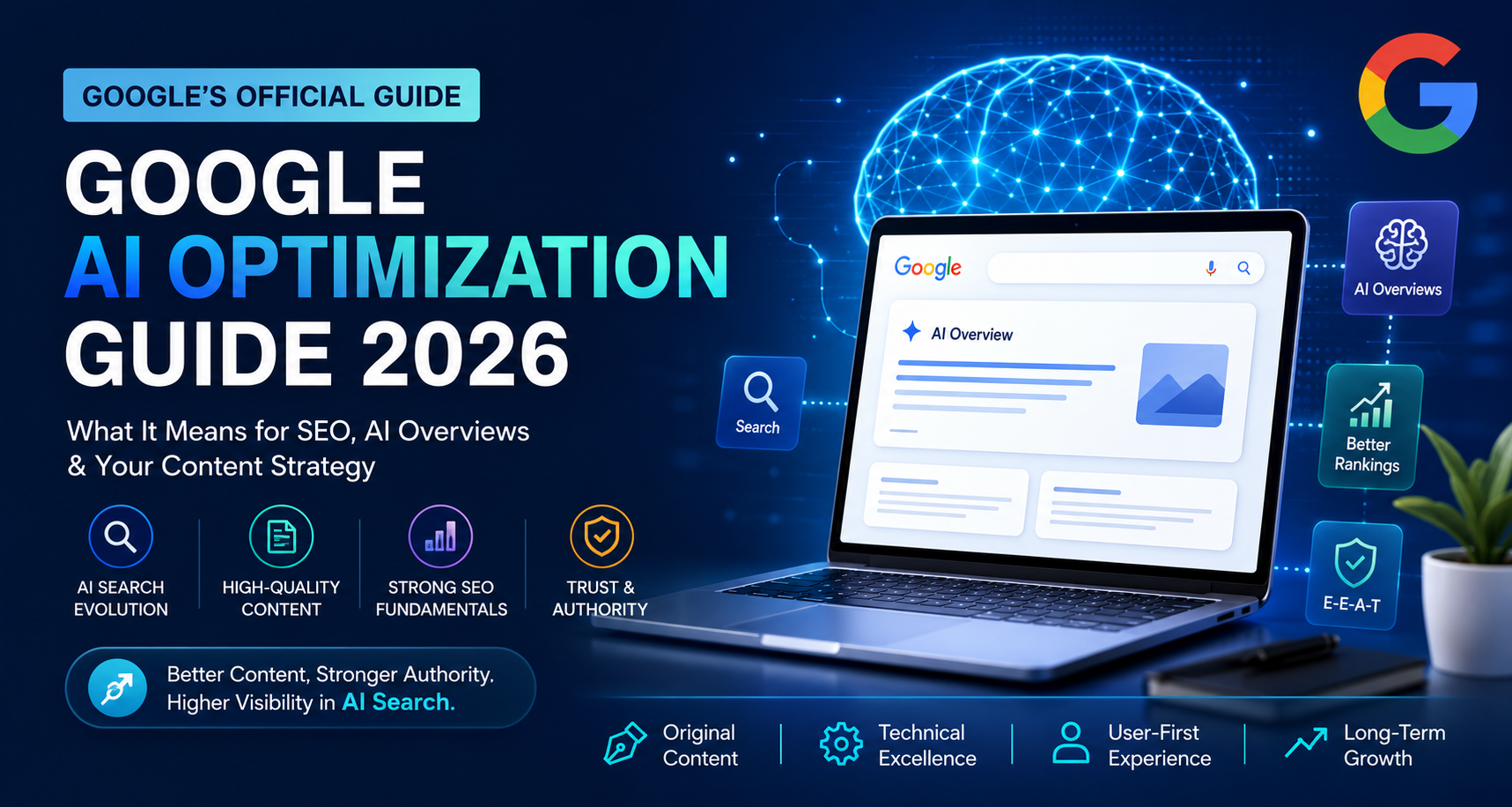
Google has officially released its AI Optimization guidance, and it’s changing how marketers think about search visibility, AI Overviews, and content strategy.
For months, the SEO industry debated questions like:
- Is traditional SEO dead?
- Do websites need GEO (Generative Engine Optimization)?
- Should brands optimize differently for AI search?
- Does Google require special AI schema or llms.txt files?
Now, Google has provided direct answers.
The new AI Optimization Guide confirms that AI search is still deeply connected to traditional SEO systems — but with stronger emphasis on content quality, originality, expertise, and user value.
If your business depends on organic traffic, understanding this update is essential.
What Is Google’s AI Optimization Guide?
Google’s AI Optimization Guide explains how websites can appear in AI-powered search experiences such as:
- AI Overviews
- AI Mode
- Generative search results
- Conversational search experiences
The guide clarifies that Google still uses its existing systems for:
- Crawling
- Indexing
- Ranking
- Content evaluation
- Search quality assessment
In simple terms: AI search is not replacing SEO — it is evolving it.
Traditional SEO Still Powers AI Visibility
One of the biggest takeaways from Google’s documentation is that AI-generated answers rely on the same core ranking systems used in traditional Search.
That means websites still need:
- Crawlable pages
- Strong technical SEO
- Helpful content
- Mobile-friendly experiences
- Fast loading speeds
- Clear site architecture
If your content already performs well in Google Search, it has a stronger chance of appearing in AI Overviews and AI Mode responses.
What This Means for Marketers
Businesses should continue investing in:
- Technical SEO
- Keyword research
- Internal linking
- Search intent optimization
- High-quality content creation
- E-E-A-T signals
The fundamentals still matter.
Google Is Prioritizing Original Content More Than Ever
Google repeatedly emphasizes the importance of creating unique, people-first content. This is especially important because AI-generated content has flooded the web with repetitive articles that offer little original value.
| Commodity Content (Low-Value) | Original Content (High-Value) |
|---|---|
|
|
This signals a major shift in SEO strategy. The websites most likely to succeed in AI search are those publishing information that cannot easily be copied.
AI SEO Myths Google Just Debunked
Google’s guide also dismisses several popular “AI SEO” trends:
- You Do Not Need llms.txt: Google does not require special
llms.txtfiles for AI visibility. - There Is No Special AI Schema: Existing structured data remains useful, but there is no dedicated “AI ranking schema.”
- AI Keyword Stuffing Does Not Work: Google’s systems already understand semantic meaning and user intent.
- GEO Is Still SEO: Generative Engine Optimization (GEO) is not a separate ranking system. Instead, it is an extension of modern SEO practices.
Why Content Structure Matters in AI Search
Although Google does not require AI-specific markup, structured content still plays an important role. AI systems need content that is easy to understand, summarize, and extract.
Recommended Formatting Practices
To improve AI extraction, featured snippet eligibility, and citations, use:
- Clear H2 and H3 headings
- FAQ sections
- Bullet points and lists
- Tables for data tracking
- Numbered steps
- Concise, direct answers
- Semantic HTML structure
Understanding Query Fan-Out in AI Search
One of the most important concepts in AI Mode is query fan-out. Instead of processing a single query literally, Google AI may break searches into multiple related subtopics.
Example Scenario:
A user searches: “Best AI SEO tools for SaaS startups”
Google AI may separately evaluate and blend data for:
- AI SEO tools
- SaaS SEO software
- Startup SEO workflows
- Content automation platforms
- Technical SEO tools
- Pricing comparisons
Why This Matters
Brands can no longer rely on isolated keyword pages. Instead, successful SEO strategies now require:
- Comprehensive topic clusters
- Deep topical authority
- Connected supporting content
- Comprehensive semantic coverage
This reinforces the importance of building robust content ecosystems rather than standalone articles.
Brand Authority Is Becoming More Important
Google’s AI systems increasingly rely on entity understanding and brand trust. This means visibility may depend heavily on:
- Brand mentions across authoritative networks
- Industry recognition and accolades
- Clear author expertise and verified creators
- Citation frequency across the web
- Topic consistency over time
- Trusted external reference links
As a result, SEO is becoming more deeply connected to overall digital PR, thought leadership, community engagement, and expert publishing. Strong brands are inherently more likely to be surfaced in AI-generated answers.
Technical SEO Still Matters
Despite all the AI discussions, Google still emphasizes technical SEO fundamentals. Important areas that demand focus include:
- Crawlability and explicit robot access
- Seamless mobile usability
- Web accessibility protocols
- Clean, compliant HTML structure
- Fast page speeds and Core Web Vitals
- Logical internal linking architectures
Without proper technical optimization, even the greatest content pieces may struggle to appear in AI-powered results.
How AI Search Changes SEO Metrics
AI search may reduce traditional click-through rates for basic, informational queries. However, the traffic that does click through to your site will likely become:
- More qualified
- Higher search intent
- More conversion-focused
This means modern SEO teams should look well beyond raw traffic volume alone.
Future SEO Metrics May Include:
- AI-assisted conversions
- Inbound lead quality
- On-page engagement rates
- Direct brand searches
- Multichannel conversion paths
- Share-of-voice visibility in AI citations
SEO success is transforming to become business-focused rather than purely traffic-focused.
How to Optimize for Google AI Search
1. Create Research-Driven Content
Publish original studies, definitive industry benchmarks, unique data analysis, in-house SEO experiments, and deep-dive case studies.
2. Build Topic Clusters
Develop connected content ecosystems around important transactional and informational themes. For example:
- ↳ AI SEO Frameworks
- ↳ Technical SEO Foundations
- ↳ B2B SaaS SEO Strategies
- ↳ AI Content Optimization Workflows
- ↳ Search Engine Automation
3. Improve E-E-A-T Signals
Incorporate comprehensive author bios, direct expert commentary, verified reference links, native screenshots, live demonstrations, and authenticated customer stories.
4. Write for Humans First
Keep your focus heavily trained on narrative clarity, factual accuracy, granular user intent, helpful direct answers, and sharing real human expertise.
5. Structure Content Clearly
Rely on scannable questions and answers, punchy short paragraphs, cleanly mapped tables, crisp bulleted lists, and clear contextual subheadings.
The Future of SEO Is Authority + Originality
Google’s AI Optimization Guide confirms a major industry shift. The future winners in search will likely be trusted brands, definitive niche experts, original research publishers, unique content creators, and strong topical authorities. Generic, surface-level AI-generated content alone will no longer cut it.
The biggest question is no longer: “How do I optimize for AI?”
The real question is: “How do I become a source AI systems trust enough to cite?”
That fundamental paradigm shift will define SEO success in the modern AI era.